Tweak

InsaneJournal

Tweak says, "Madness! Sheer madness!"

Username: 
Password:    
Remember Me
  • Create Account
  • IJ Login
  • OpenID Login
Search by : 
  • View
    • Create Account
    • IJ Login
    • OpenID Login
  • Journal
    • Post
    • Edit Entries
    • Customize Journal
    • Comment Settings
    • Recent Comments
    • Manage Tags
  • Account
    • Manage Account
    • Viewing Options
    • Manage Profile
    • Manage Notifications
    • Manage Pictures
    • Manage Schools
    • Account Status
  • Friends
    • Edit Friends
    • Edit Custom Groups
    • Friends Filter
    • Nudge Friends
    • Invite
    • Create RSS Feed
  • Asylums
    • Post
    • Asylum Invitations
    • Manage Asylums
    • Create Asylum
  • Site
    • Support
    • Upgrade Account
    • FAQs
    • Search By Location
    • Search By Interest
    • Search Randomly

starwolf_oakley ([info]starwolf_oakley) wrote in [info]scans_daily,
@ 2009-08-07 00:53:00

Previous Entry  Add to memories!  Tell a Friend!  Next Entry
Entry tags:char: blockbuster/roland desmond, char: robin/nightwing/dick grayson, char: tarantula/catalina flores, creator: devin grayson, title: nightwing

NIGHTWING #93: A sample of Devin Grayson's work
Given how much Devin Grayson's run on NIGHTWING has been discussed on my previous post, I thought some pages from said run might be appreciated.

This can be considered the climax of the "Born Again 2: Electric Boogaloo" storyline in NIGHTWING. In more ways than one. (D'oh!)


Blockbuster has torched Haley's Circus, blown up Dick's apartment building (killing most of the tenants), almost blown up Bludhaven's police station, and killed a reporter who was standing right next to Nightwing. Then Blockbuster dramatically jumping into the hotel room.
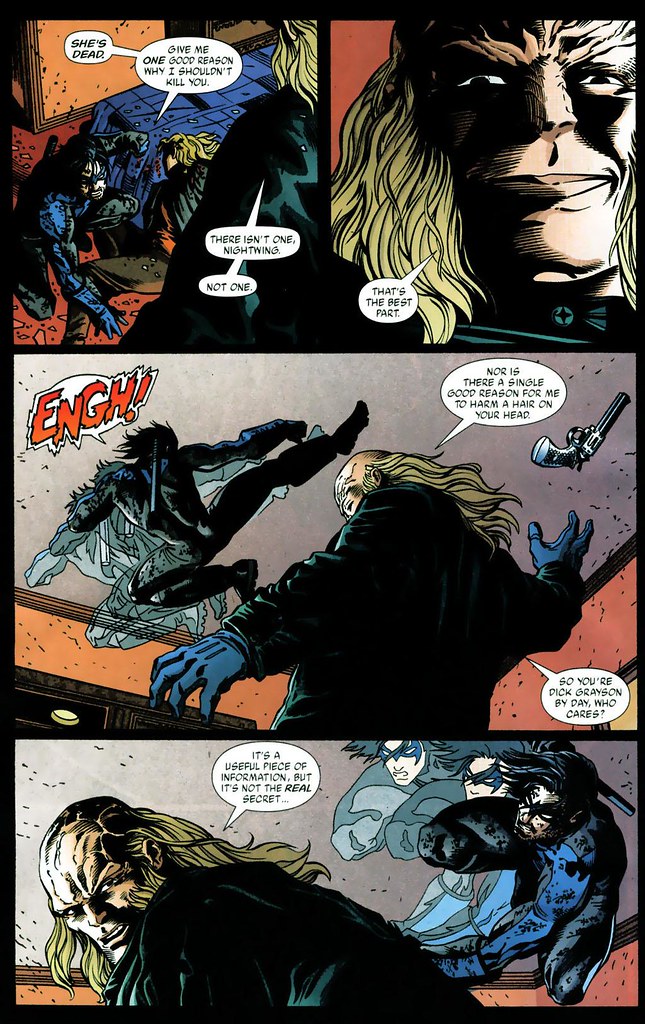
Nightwing #93 - Page 9

Okay, "Roland," what's the real secret?
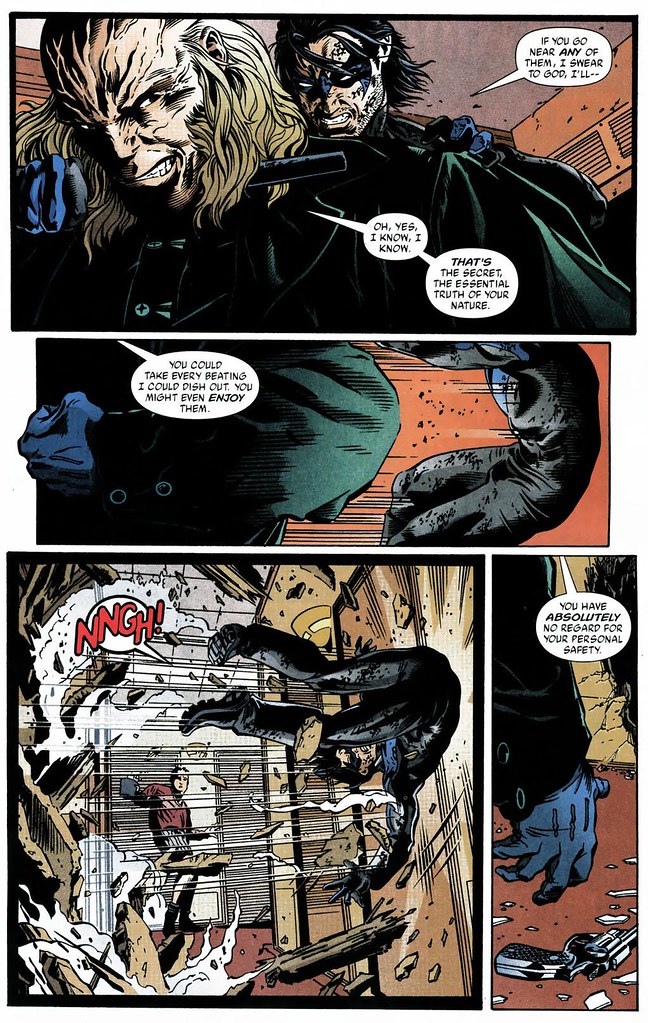
Nightwing #93 - Page 10

"But the people around you are a different matter. Blockbuster tries to shoot a random hotel guest in the hallway, but Nightwing stops him.

Hey, I know Dick was trained/raised by Bruce Wayne, but he wouldn't enjoy physical punishment. I hope.

Oh, part of the problem here is Blockbuster blames Nightwing for his mother's death. I don't quite know why he does, but he does.
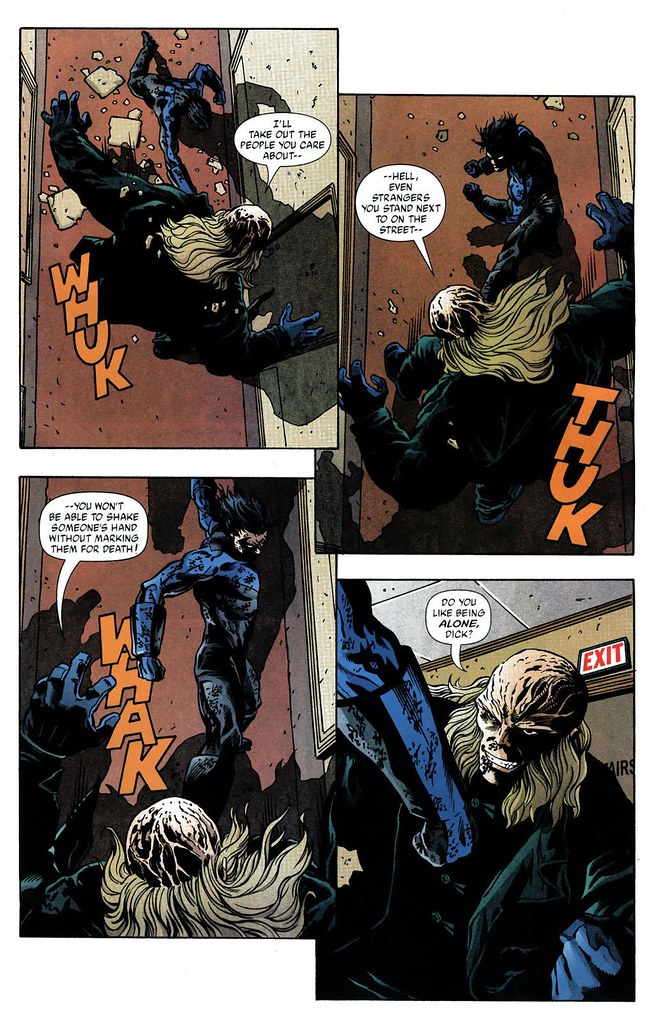
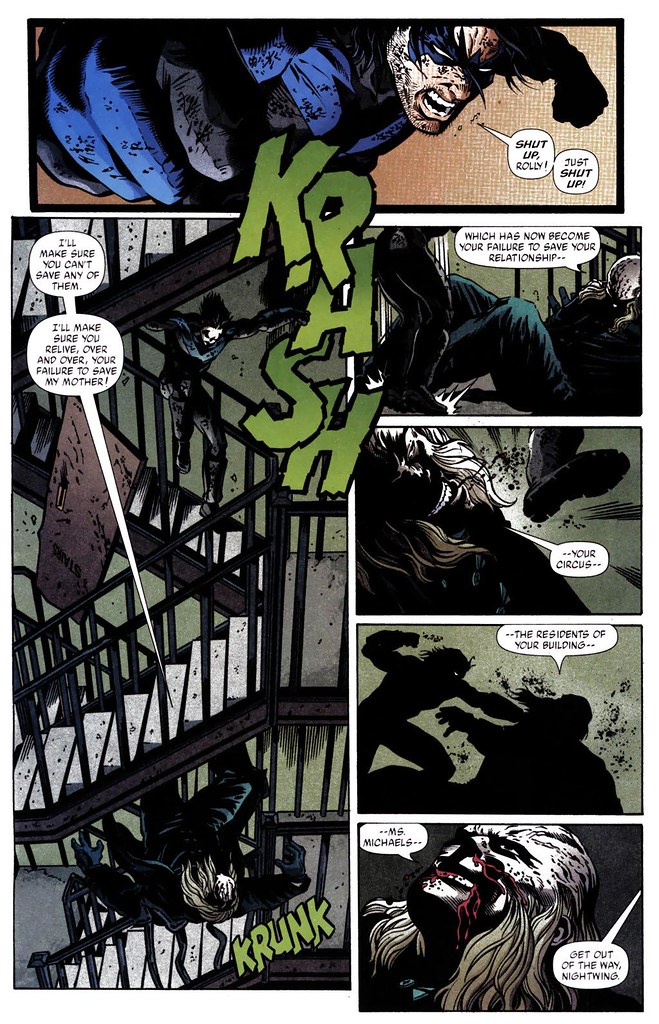
Nightwing #93 - Page 12

Nightwing #93 - Page 13

No, I don't know what, if anything, Blockbuster did to break up Babs and Dick.

Hey, who is that talking?
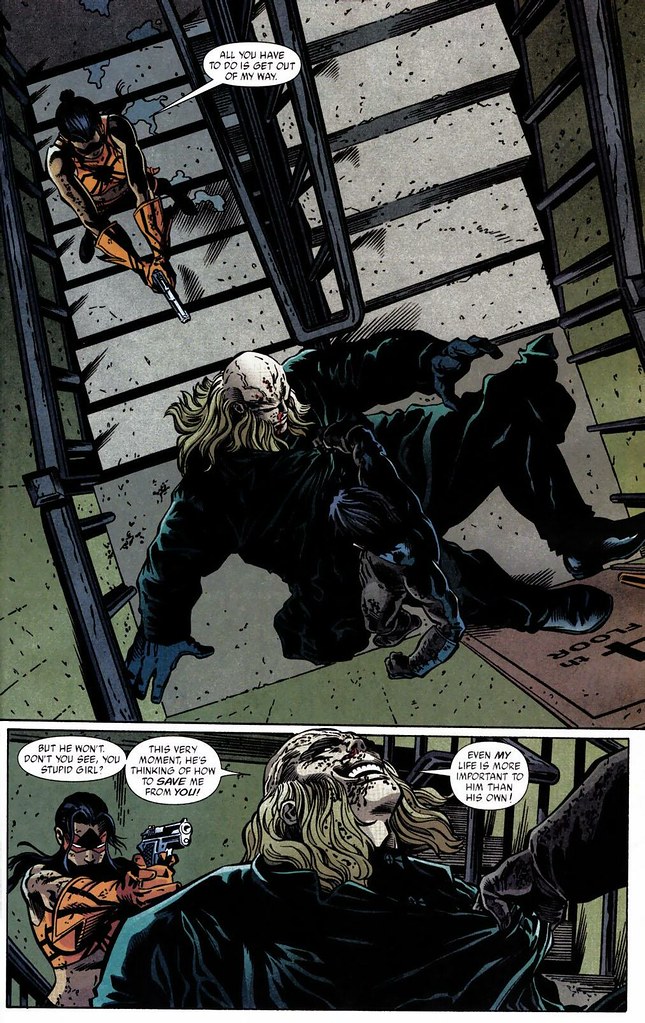
Nightwing #93 - Page 14

Hey, it's Tarantula. She may be Devin Grayson's "Mary Sue," but I really hope not.
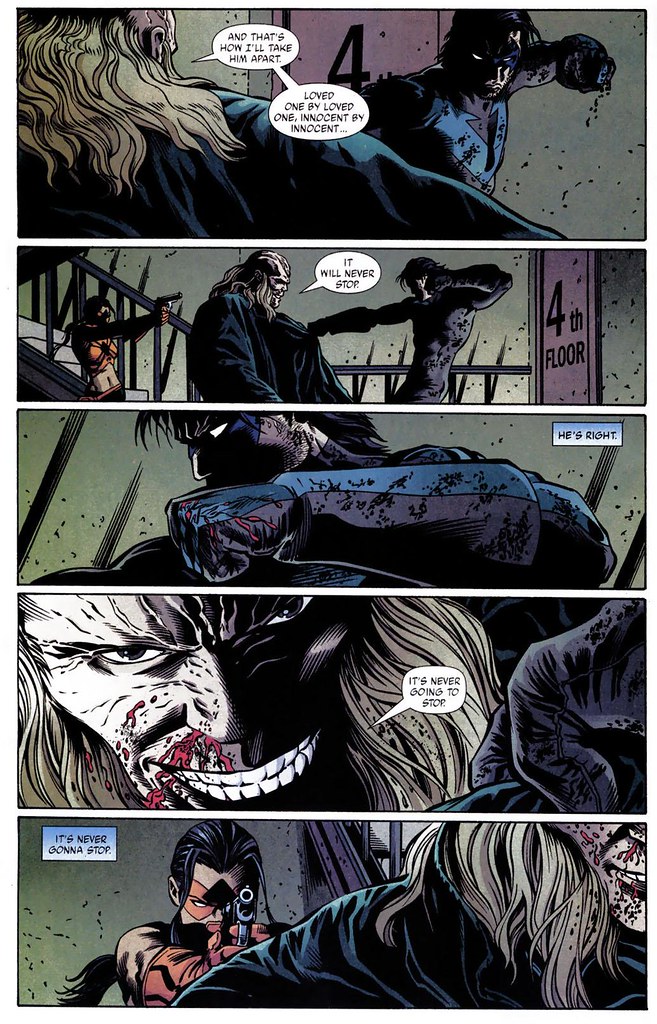
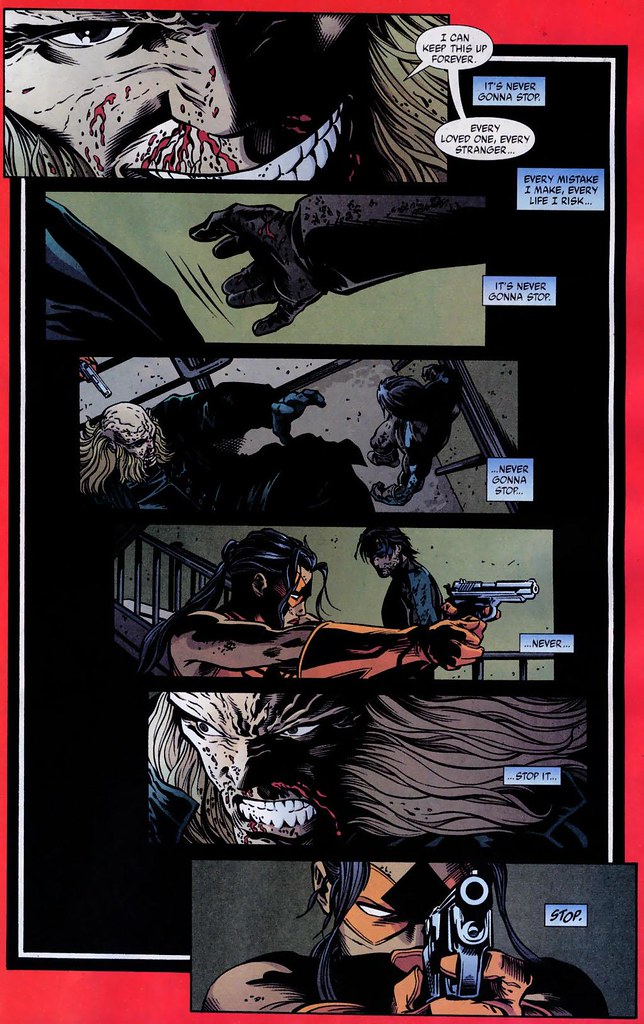
Nightwing #93 - Page 15

Nightwing #93 - Page 16

So, Tarantula shoots and kills Blockbuster. Nightwing (splattered with Blockbuster's blood) freaks out some more, runs up to the roof, and he and Tarantula have non-consensual rooftop sex while Blockbuster's body is still warm. Remind me how this means Tarantula is Grayson's "self-insertion" character?


(Read comments) - (Post a new comment)


[info]sistermagpie
2009-08-07 03:20 pm UTC (link)
I like using it for original fiction and have always defended it's used there.

*But*

I think you're right about it's overuse. I tend to use it for specific moments of a character so I can explain exactly what I mean by it. There are characters that I wouldn't label as a Mary Sue in general but I think it's often just the right word to describe something going on.

For instance, I remember reading an article about Madeline L'Engle and her editor at one point criticized her characterization of a character by essentially saying she was a Mary Sue--but without using taht word. She said that the character was always right, that she was always lecturing other people on what to do and was right, in any situation she was the one in the right. And M L'E made changes that the character became much more likable--and I think the character was as close to a self-insert as she had in the book.

In cases like that I do think it's the correct word. It just means you're obviously setting up characters to make another character look good. But you're not necessarily always doing that.

But still it can be a tricky word to use because so often as soon as it gets used people start arguing about what qualities every Mary Sue needs and arguing about the definition rather than the character, so it's best to drop it and just describe what it is you think the author's doing that you don't like. Especially when, as you say, it's a new character that naturally has to establish themselves as competent to play their role in the story.

(Reply to this) (Parent) (Thread)


[info]kagome654
2009-08-08 04:19 am UTC (link)
It just means you're obviously setting up characters to make another character look good. But you're not necessarily always doing that.


I think that depends on how it is done. Setting up characters to be deliberate foils for one another, intentionally using one character (and their methods) to demonstrate why another character may be wrong, is a perfectly legitimate technique in fiction (more so in some genres than others). It only becomes a problem when the second character is being written in a way that is contrary to their previously established character, and I wouldn't call the first character a Mary Sue because of it. If we're going to get really technical that's something I like to refer to as 'shitty writing.'

I think it's even worse in comics than most, take for example the fact the title character is GENERALLY going to come off looking better when it comes to conflicts with guest stars in his or her own book, even when the guest star could legitimately give the title hero a hard time under 'normal' circumstances. That sort of thing doesn't, imho, make anyone a a Sue. It's just...predictable.

I do get what you're saying, maybe they are Sueish 'moments.' I'm probably just a little ticked because a lot of the characters I like are (fairly or not) accused of being Sues, and I prefer to assume that I'm right and everyone else is wrong rather than accept I buy into hype and Sueish displays of forced awesomeness.

(Reply to this) (Parent) (Thread)


[info]sistermagpie
2009-08-08 02:36 pm UTC (link)
It only becomes a problem when the second character is being written in a way that is contrary to their previously established character, and I wouldn't call the first character a Mary Sue because of it.

That's interesting--because I can think of times when I have--usually because it seems like Character A is only feeding lines to set up zingers from Character B. Even if it's not entirely OOC for Character A to say something stupid, if it becomes too much of a pattern so I expect any scene with Character B to have set ups like that, it becomes Sue-ish to me.

Really, when you think about it, it's just about suspension of disbelief, which is why some characters that see like totally MS's to some aren't to others and both of them can be right. It's mostly about the moment when you feel like the author isn't paying attention to the stories or the other characters and how they would really work because their priority is doing whatever they want to do with another character.

Not that fiction isn't always about manipulating things that way, but when you become aware of it or it feels fake it doesn't work.

So yeah, shitty writing definitely covers it too!

And also, you're totally right about comics, especially superhero comics. Pretty much everyone has to establish themselves as competent to be taken seriously at all, and in order to be competent against superheroes you have to be...really competent. I know there's a lot of times when people have been upset about one hero or another taken down at first that doesn't really bother me. If the heroes don't get beaten they can't rise up and win the day.

(Reply to this) (Parent)


(Read comments) -


Home | Site Map | Manage Account | TOS | Privacy | Support | FAQs